Learning About Your WWI Relative
We are planning a major upgrade of this feature during the summer of 2009. We intend to cover more types of inquiries and to accommodate researching all combatants of the Great War.
Please check back.
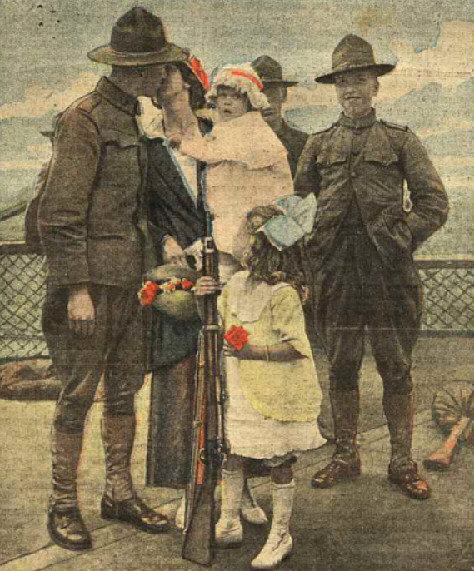 Departing for France
Frequently Asked Questions
Online resources mentioned in the replies to the questions can be found in the side-bar on the right.
Is it true that almost all World War I military records kept at the St. Louis National Personnel Record center were lost in a fire?
The 1973 fire destroyed [many but not all] U.S. Army personnel records created from 1912 to 1963, but it did not damage U.S. Navy and U.S. Marine Corps personnel files. See NARA article for details.
Despite the fire at the National Personnel Records Center, I want to see if they have any information on my grandfather. How can I start this process?
To request a search of personnel records in the National Personnel Records Center, you will need a Standard Form 180, "Request Pertaining to Military Records." Copies of the form are available from the center at 8600 Page Boulevard, St. Louis, MO 63132, or from their Web site [on the right]:
Of course, any governmental form is going to have some tricky parts. In ordering a file from St. Louis that you MUST include the military service number. If you do NOT include the military service number, you will wait 6-9 months and St. Louis will return the request telling you they cannot process the request without the military service number, no exceptions.
An alternative approach is suggested by Genealogist Lynna Kay Shuffield [See the last question below for information on her Web site.] In her article on "WWI Statement of Service Cards", records of service that were sent to the Adjutant General of every state, she lists where to write for this resource in every state. You don't have to have the military service number to get this record. Once you have this card, and it will have service number on it, you can then write to St. Louis.
I've had no luck with official records on my WWI relative. I want to learn what his experience was like. How can I get started to do my own research with published sources?
The key to getting started is to learn your relative's unit.
If the official approach has failed you, there are other ways, some unofficial, to dig up his unit. Here is a list of places to check:
1. What was his home state at the time of the war? Many states published summary volumes listing the military service of every citizen during the war. Check at his state governmental library and archives.
2. Who disposed of his personal effects when he died? A relative? An executor? Find them and see what happened to his personal effects and check to see if there were any military papers, letters home, a diary he kept overseas, information about where he went to training camp, and so forth.
3. Where is he buried? Check the records at the cemetery.
4. When did he die? Was there an obituary? Is there any one left who knew him after the war that he might have spoken to about his military experience?
5. Did he belong to any veterans organizations? They usually keep information on the affiliations of members.
6. Does any one have a photo of him in uniform or a some souvenirs from the war (example below).
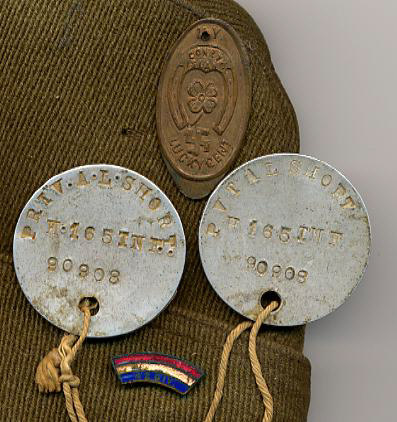
Souvenirs of Private A.L. Short give a wealth of information about him. The small medallion indicates he was a member of New York's Irish "Fighting 69th" National Guard Regiment. The identity disks give his name, rank and service number, as well as his unit, the 165th Infantry, which was the new designation assigned the "Fighting 69th" in the AEF. The regiment was a component of the 42nd "Rainbow" Division, hence the rainbow badge.
How can I learn the details of how my grandfather was wounded in World War I?
The National Archives holds reports on most of the 300,000 men wounded in the war. These include reports on Casualties, or Wound Chevron special orders, which can provide valuable military service information, including types of injuries and location of service. (NARA, Records of the U.S. Regular Army Mobile Units, 1821-1942, RG 391)
If he was killed in action, Lynna Kay Shuffield has also written an excellent online article on researching World War I Burial Case Files.
What were the Gold Star Mothers. Did they make a trip to Europe to visit their son's graves?
Mothers whose sons were buried overseas were able to make a pilgrimage to their son's grave at government expense. Learn more about this program at article:
"World War I Gold Star Mothers Pilgrimages" by Constance Potter and at "America and the Akins Family Lose a Son" from Marty Beatty.
How do I learn about the military experience of my relative in the Great War without getting involved with government archives?
Depending on how deeply you wish to study and research published and generally available Sources we suggest three levels of inquiry.
1. For a general introduction to the operations of the American Expeditionary Forces:
THE WAR TO END ALL WARS, E.M. Coffman
A top-down look at the AEF.
OVER THERE, Frank Freidel
Best photo album of the AEF, supplemented by firsthand experiences from the Doughboys.
THE DOUGHBOYS, Gary Meade
An updated account modeled on Lawrence Stalling's classic of the same title [also recommended].
2. For detailed information on every AEF unit and operation:
AMERICAN ARMIES AND BATTLEFIELDS IN FRANCE, GPO
A unique combination battlefield tour guide, history, atlas, photo album and statistical abstract.
ORDER OF BATTLE OF UNITED STATES LAND FORCES IN THE WORLD WAR, 1917-1919, U.S. Army, 3 volumes.
Detailed, important information about every AEF unit.
WORLD WAR I: THE U.S. ARMY OVERSEAS, U.S. Army Center for Military History
Brief summary of the history and operations of the AEF [available online].
3. For very specific information on your relative's military service.
If, say, you are looking for the specific action in which your relative won his Silver Star, you must go to the detailed unit histories. These are most informative and detailed for divisions and regiments. Here are some tips for finding unit histories [Armies, Corps, Divisions, Regiments]:
The U.S. Army Military History Institute maintains on online library of unit history bibliographies.
But how to find these works?
1. Military history book dealers, especially specialists in the First World War, are worth a check. Some of the unit histories are now being placed on line. Trying "Googling" using the name of the unit, e.g., "363rd Infantry Regiment."
2. Certain libraries, archives and depositories have very large collections of WWI works. These include the New York Public Library, the Hoover Institution at Stanford University and Cantigny - The First Division Foundation and Museum at Wheaton, Illinois.
3. Try the larger local and universities in your area and see if the can order works via interlibrary loan.
4. If he was assigned to an Army division, try to find out what states provided the bulk of the manpower for that division. There is a helpful list in Laurence Stalling's book THE DOUGHBOYS. Check at the big city libraries, state university libraries, historical societies and state library and archives for that state. This approach of course does not work for aviation units or specialized units not assigned to divisions. Also, remember that the U.S. Marines in the Great War fought under the Army's 2nd Division.
My relative was killed in action during the war. I understand he was entitled to received the Purple Heart, but it was never awarded posthumously. Can the family apply for the award of the medal?
Yes, although you will probably have to provide some evidence of his service and his death in the war. Consult the "Purple Heart" and "America and the Akins Family Lose a Son" links on the right for details.
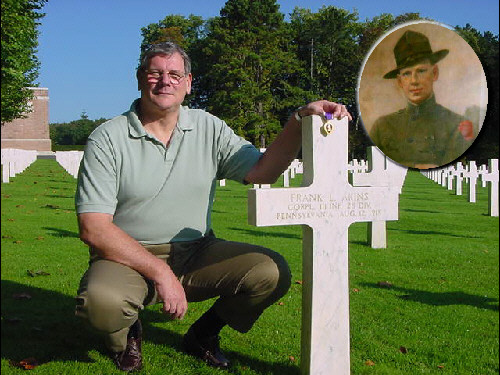
Member Marty Beatty at the grave of his uncle Frank Akins (insert) of the 28th Pennsylvania Division at the Oise-Aisne Cemetery in France. In 2001, helped by information from an early version of this Web page, Marty organized his family's effort to receive Frank's Purple Heart medal (shown), which had not been previously awarded. Frank Akin's Aunt Kass was a participant in the Gold Star Mothers' visit to the same grave in 1930. Marty Beatty contributed material for the article "America and the Akins Family Lose a Son," covering Frank's service and his family's subsequent experiences.
My great grandfather was drafted during the Great War. Is there an online source for his draft registration record?
Yes, see the links listed on the right.
My great uncle was in the National Guard of Colorado and served with their National Guard division during the war. Can I check their records of his service?
Yes, National Guard unit records are not federal records but are in the custody of state repositories or the Adjutant Generals' offices. THE GENEALOGIST'S ADDRESS BOOK, by Elizabeth Petty Bently (Genealogical Publishing Company, Inc., 1995) lists many of these repositories. [From NARA]
How can I find out more about my late relative's disability payments and benefits?
Contact a Department of Veterans Affairs (VA) office in your vicinity to determine if a World War I veteran received a pension or other government benefits.
My relative was a mechanic in the Air Service. How do I find his unit?
Documentation on personnel serving in the Air Service is normally found among the rosters included in Gorrell's History of the American Expeditionary Forces Air Service, 1917-1919, entry 644, Record Group 120. This history has been microfilmed by NARA on 58 rolls as publication M990 and is available for examination in the Microfilm Research Room at the National Archives in Washington, D.C., or for purchase from the National Archives Trust Fund. [From NARA]
Dedicated To: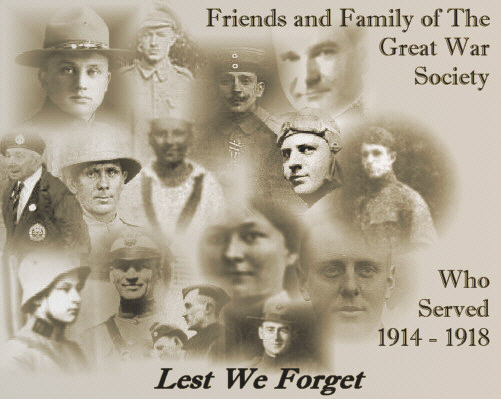
|
|
Online Resources
For the Genealogical Researcher
|
|


